

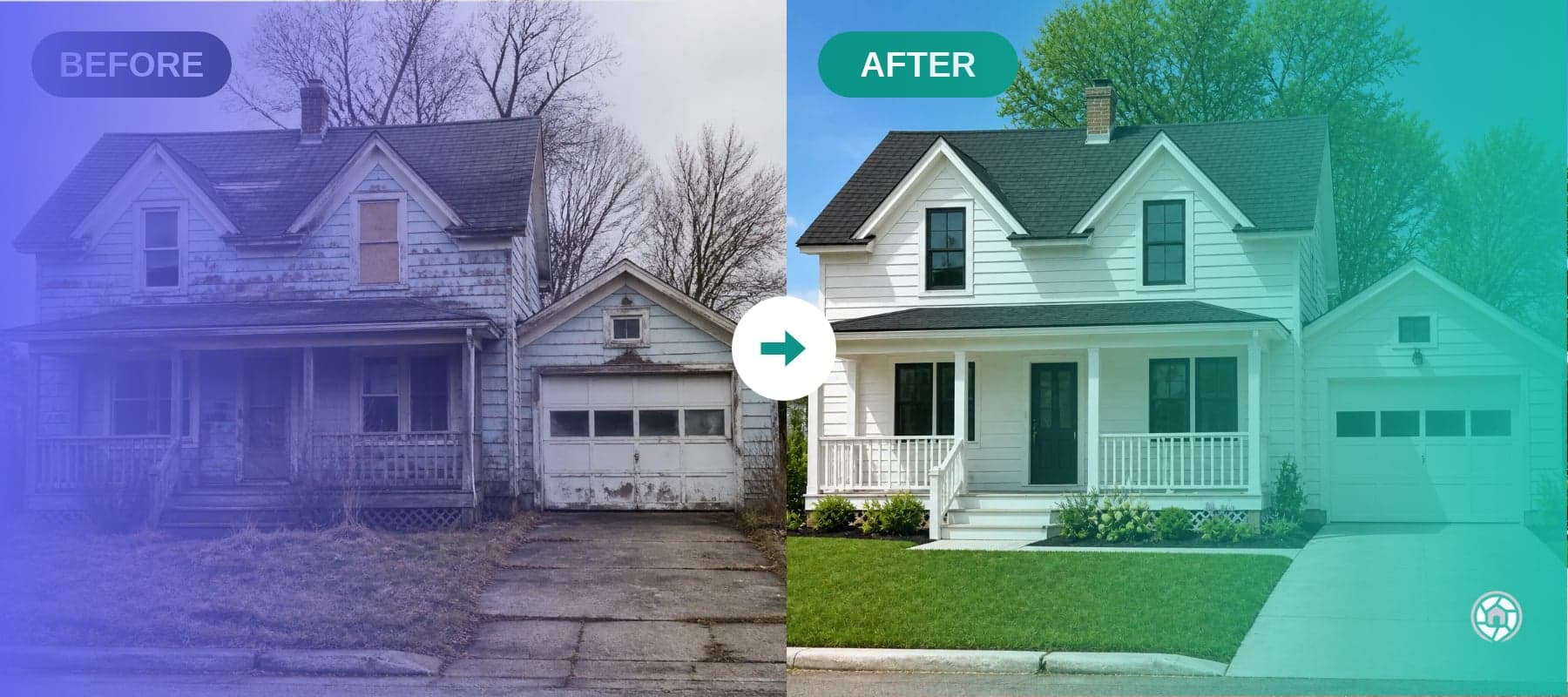

Most fixer-uppers never show up on a listing site. Listing sites only show the homes on the market right now, which is roughly 1% of all homes, and every other buyer in town is looking at the same ones.
So we ran the numbers on the rest. DealMachine identifies 2,664,473 single-family homes with an estimated repair cost of $75,000 or more, an absentee owner, and at least 50% equity. These aren't listed. They're off-market homes whose owners may be willing to sell. Here's where they are and how to work them.
How We Built This Ranking
Let me clarify what the numbers mean before we get to the tables. A home made our list only if it met all four of these:
- Single-family home. No condos, townhouses, or multifamily.
- Heavy rehab. DealMachine's estimated repair cost is $75,000 or more.
- Absentee owner. The owner doesn't live in the home.
- At least 50% equity. The owner owes less than half of what the home is worth.
One important note. DealMachine's estimated repair cost is a planning number, not a contractor bid. It's based on the home's condition, age, and size, so it rises with square footage. A 3,000-square-foot house will cross $75,000 faster than a 1,200-square-foot house in the same shape. All counts were pulled from DealMachine's property data in October 2026.
Top 10 States for High-Equity Fixer-Uppers
Here's the ranking by motivated fixer-uppers: heavy-rehab homes with an absentee owner and at least 50% equity. The last column shows how many heavy-rehab homes in each state have an estimated value under $200,000.
| Rank | State | Est. Repairs $75K+ | Absentee + 50% Equity | Value Under $200K |
|---|---|---|---|---|
| 1 | California | 2,178,723 | 244,924 | 1,492 |
| 2 | Texas | 2,767,991 | 235,392 | 63,003 |
| 3 | Florida | 1,776,083 | 190,695 | 16,705 |
| 4 | North Carolina | 1,064,834 | 155,878 | 17,340 |
| 5 | Georgia | 1,122,110 | 116,865 | 23,040 |
| 6 | Arizona | 663,299 | 100,478 | 704 |
| 7 | Washington | 672,663 | 94,811 | 876 |
| 8 | New Jersey | 794,100 | 91,456 | 884 |
| 9 | Colorado | 672,121 | 88,820 | 2,415 |
| 10 | New York | 670,826 | 82,697 | 19,428 |
| U.S. Total | 24,231,628 | 2,664,473 | 768,400 |
Texas actually has more heavy-rehab homes than California, about 2.77 million vs. 2.18 million. California pulls ahead once you filter for absentee owners with high equity. That's the filter that matters for investors, because it points to owners who have both a reason to sell and room to accept a discount.
Where the Affordable Fixer-Uppers Are
The top 10 list tells you where the volume is. It doesn't tell you where a first-time investor can afford to buy. For that, we looked at homes with DealMachine's estimated repair cost of $75,000 or more and an estimated value under $200,000.
| State | Heavy-Rehab Homes Under $200K | % of Single-Family Homes |
|---|---|---|
| Texas | 63,003 | 0.8% |
| Indiana | 55,563 | 2.7% |
| Pennsylvania | 49,955 | 1.5% |
| Ohio | 45,903 | 1.3% |
| Mississippi | 36,729 | 3.7% |
| Iowa | 33,254 | 3.2% |
| Missouri | 31,560 | 1.6% |
Alabama is not included because its numbers are still being verified.
What the Data Shows
The Sun Belt has the volume. The Midwest has the price point.
California has 244,924 motivated fixer-uppers, but only 1,492 heavy-rehab homes worth under $200,000. Arizona (704) and Washington (876) look the same. Meanwhile, Indiana, Pennsylvania, and Ohio each have tens of thousands. If your budget is tight, the Midwest is where the math is most likely to work.
Small states rank high on concentration.
Mississippi (3.7%) and Iowa (3.2%) have the highest share of affordable heavy-rehab homes. Their raw counts are lower, but a bigger share of the housing stock fits the profile. In practice, that means fewer wasted calls and mailers per deal.
About 1 in 9 heavy-rehab homes has a motivated owner.
That's 2.66 million out of 24.2 million, or 11%. Most people who own a rough house live in it and aren't thinking about selling. The absentee and equity filters narrow the list to owners who don't live there, may be tired of managing it, and can sell below retail without coming out short. If you've used our vacant property leads by state ranking, think of this as the companion list. That one tells you whether anyone lives in the home. This one tells you how much work the home needs.
Who This Data Is For
Two groups get the most out of this list:
- First-time flippers. Start in the affordable states, where the purchase price plus repairs can fit a smaller budget or a single hard money loan.
- Wholesalers. Go after the motivated list. An absentee owner with 50% or more equity can accept a discounted offer and still walk away with cash. That's what makes the assignment spread possible.
How to Find Fixer-Upper Homes in Your Market
This isn't complicated, but you do need the right process. Most beginners asking how to find distressed properties start with a list that's too broad. Here's the process I'd follow instead.
- Pick one market. Start with a county, not a whole state. You need to know local values well enough to trust your numbers.
- Set your filters. In DealMachine, choose single-family, estimated repair cost of $75,000 or more, absentee owner, and estimated equity of 50% or more.
- Check the repair number. Run each lead through the DealMachine rehab estimator, then compare it to our guide on estimating rehab costs.
- Run the deal math. Use the after-repair value (ARV) and the 70% rule to set your maximum offer.
- Walk the property before you make an offer. Data gets you to the right door. It doesn't replace seeing the foundation, roof, and wiring yourself.
Let me give you a simple example. Say a house in Indiana has an ARV of $180,000 and needs about $75,000 in work.
- $180,000 × 70% = $126,000
- $126,000 − $75,000 in repairs = $51,000 maximum offer
Now here's the part that matters. If that home is worth $100,000 as-is and the owner has at least 50% equity, they owe $50,000 or less. A $51,000 offer can pay off their loan. Without the equity filter, you'd be making offers that many owners can't accept. For more on the formula, read our breakdown of the 70% rule in house flipping.
Find Off-Market Fixer-Uppers in Your Market
The listed fixer-uppers are the ones everyone sees. The 2.66 million off-market ones are where the opportunity is. Find off-market fixer-uppers with high equity and absentee owners in your market. See DealMachine plans and get started.
Frequently Asked Questions
How do I find fixer-upper homes that aren't listed for sale?
Use property data to filter for homes with high estimated repair costs, absentee owners, and strong equity. Then contact the owners directly by mail, phone, or text. These homes aren't on the market, so you're starting the conversation instead of competing with other buyers. If you've been searching for fixer upper homes for sale near me and only finding listings, this is the step most people skip.
Is buying a fixer-upper worth it?
It can be, if you buy at the right price. The profit is set when you buy, not when you sell. If your purchase price plus repairs stays at or below 70% of ARV, you have room for surprises and still make money.
How much does it cost to renovate a house?
It depends on size, age, and condition. DealMachine's repair estimate multiplies a cost per square foot for the home's condition by its living area, so bigger homes cost more to fix. Use it to screen deals, then get contractor bids before you close.
What is ARV in real estate?
ARV stands for after-repair value. It's what a home should sell for once all repairs are done, based on recent sales of similar updated homes nearby. Investors use it to work backward to a maximum offer.
Can you wholesale a fixer-upper?
Yes. Heavy-rehab homes are some of the most common wholesale deals, because cash buyers and flippers want them and many owners don't want to fix them. Check your state's wholesaling rules before you sign your first contract.