•




How to Build a Compliant Virtual Solar Call Center That Actually Books Installs: overview
Quick answer: Most solar companies don’t need another motivational talk.
What this guide covers
- Why Virtual Solar Call Centers Work So Well Right Now
- What “High-Performance” Actually Means in a Solar Call Center
- The 5 Daily KPIs for a Solar Call Center
- 1. Hours Worked
Most solar companies don’t need another motivational talk. They need a virtual call center that reliably turns homeowner data into appointments and installs.
This blog breaks down a practical, numbers-first way to build a high-performance virtual solar call center, based on a live masterclass with operators who are actually doing it: running 10,000+ dials a day, closing deals from Mexico and Colombia, and cutting service truck rolls by ~30%.
If you are building a virtual solar call center at scale, performance is only part of the job. It also needs to be built in a way that supports compliance. The right systems should help you book more appointments while reducing avoidable risk.
Why Virtual Solar Call Centers Work So Well Right Now
Here’s what is happening in the market.
Two things are driving performance at the same time:
Summer bill shock
Homeowners go from ~$70 bills to ~$150+ and finally care enough to act. My team closed 4 deals on one Friday because of that jump.
Best solar markets aren’t always local
Incentives, utility rates, and payback periods change by ZIP code, not by where your office is.
.jpg)
If your best markets are in Arizona, Texas, or a specific utility pocket, but you live somewhere else, door-to-door alone will hit a ceiling.
A virtual solar call center lets you:
- Target owner-occupied homes near the median home price in your best markets.
- Filter out harder buckets (very young owners, 75+ owners, heavy HOAs) so approvals and value are more likely.
- Put reps on a dialer talking to someone every ~30 seconds instead of every 5–10 minutes.
- Listen to calls, coach in near real time, and reach more homeowners than any field-only team can cover.
Your real territory becomes your data, not your office ZIP code.
What “High-Performance” Actually Means in a Solar Call Center
“High-performance” does not mean:
- More hype on morning Zooms
- Longer scripts
- Fancy dashboards nobody checks
High-performance means you can answer five simple questions every day for each rep:
- How many hours did they actually spend dialing?
- How many dials did they make?
- How many people answered?
- How many leads did they create?
- How many wrong numbers did they hit?
From there, you can see who needs coaching, whether your data is bad, or whether your dialer or caller IDs are the real problem. Most beginners skip this. They only track “deals this month” and then say “it’s slow” without knowing which part broke.
The 5 Daily KPIs for a Solar Call Center
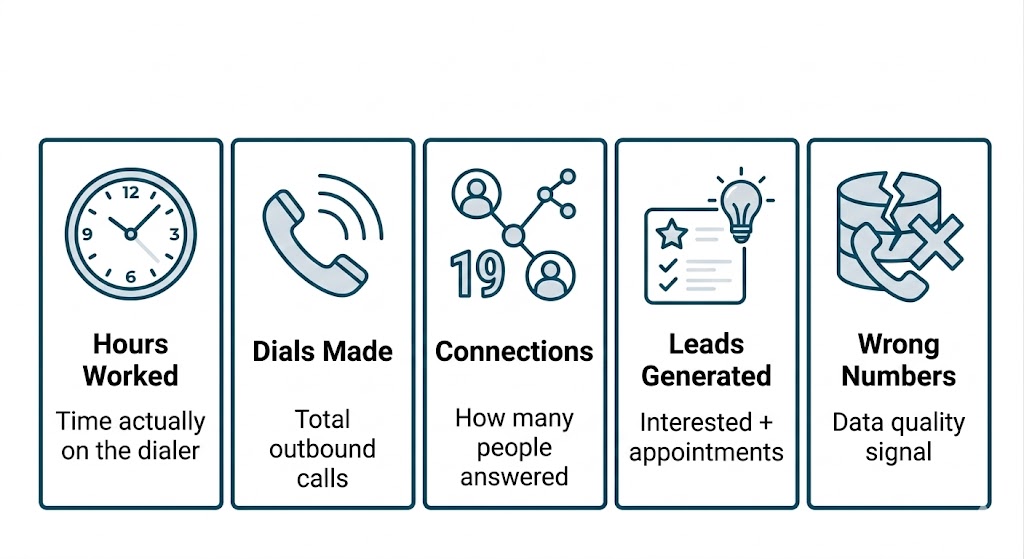
Every rep, every day, should be tracked on these five KPIs:
1. Hours Worked
Time actually on the dialer.
No admin, no bathroom, no “Wi-Fi issues.”
Use a time-tracking tool (for example, Hubstaff) and only pay for active cold-calling time.
2. Dials Made
Total outbound calls placed.
You use this to calculate dials per hour and spot time theft or dialer issues.
3. Connections
How many people answered the phone.
This feeds your contact rate, which is a core metric for the whole operation.
4. Leads Generated
For solar, define this in two tiers:
- Interested Party – Willing to keep talking.
- Appointment Set – Booked date and time on the calendar.
Track both.
5. Wrong Numbers
Invalid or incorrect contacts.
This is your data quality signal.
Have your team post these five numbers at the same time every morning in a group chat for the previous day. The raw data can live in a spreadsheet, but the numbers should be pushed to you and your leaders automatically.
The 5 Derived Metrics That Predict Appointments and Installs
From those five KPIs, calculate these metrics. They explain your results:
1. Contact Rate
Formula: Connections ÷ Dials
Healthy range for large-scale outbound: 9–15%.
If this drops, fix it before anything else.
2. Accuracy Rate
Formula: Right Contacts ÷ (Right Contacts + Wrong Numbers)
Goal: 80%+ of connections are the right person.
Under 75% means your data vendor or skip-tracing method needs review.
3. Dials per Hour
Formula: Dials ÷ Hours Worked
On a triple-line dialer, target 160+ dials/hour.
Under 150 is a concern.
Under 140 usually means someone is clocked in but not really dialing.
4. Leads per Hour
Formula: Leads ÷ Hours Worked
This is the #1 skill metric for each rep.
Baselines we discussed on the call:
- Many foreign solar callers: ~0.33–0.35 leads/hour (about 1 lead every 3 hours).
Use this to decide who needs training, who is average, and who is carrying the team.
5. Dials per Lead
Formula: Dials ÷ Leads
This tells you how hard the market is and what “normal” looks like. It helps you explain to the team how much work it takes to generate each lead.
Put these metrics in a calendar-style sheet (rows = days, columns = metrics). You’ll quickly see patterns—for example, if contact rate tanks on Tuesdays, you likely have a caller ID or dialer setup issue; if one rep’s dials per hour are far below everyone else, you may be seeing time theft or a dialer that isn’t running; if leads per hour drop across the board, you probably have a script or rebuttal issue, not “bad leads.”
A Simple Daily Scoreboard Workflow
Here’s the process we walked through on the call:
- Reps log cold-calling-only hours in a time tracker.
- At a fixed time (example: 9 AM), a leader posts each rep’s five KPIs in a group chat.
- A spreadsheet tracks each day in a month view:
- Hours, dials, connections, leads, wrong numbers
- Contact rate, accuracy rate, dials/hour, leads/hour, dials/lead
Your job as the leader is to scan for changes, not perfection; ask, “Why did this metric change?” instead of “How does everyone feel?”; and check whether your leaders are acting on the numbers or waiting for you. You don’t need a BI tool to start. You need consistent tracking.
When Metrics Drop: What to Fix First
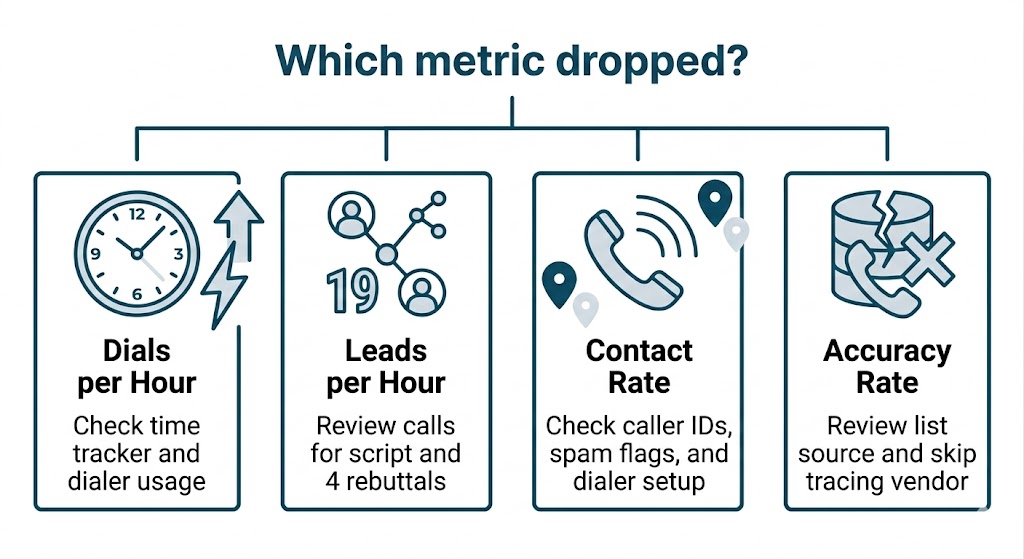
Here’s a quick reaction playbook.
1. Dials per Hour Are Low
Signal: Under 150 on a triple-line dialer.
Meaning: Someone is getting paid but not really dialing.
What to do: Review screenshots or activity in your time tracker, confirm they were on the dialer (not on social feeds or idle screens), and address it that day so it doesn’t become normal.
2. Leads per Hour Are Low
Signal: Rep’s leads/hour are below your floor (for example, under 0.33).
Meaning: Script not followed or objections not handled.
What to do: Pull several “not interested” calls from that rep and listen for four rebuttals before they end the call. If they’re not using rebuttals, retrain for two weeks; if numbers don’t recover, let them go. You’re not punishing them. You’re enforcing the process they were trained on.
3. Contact Rate Drops
Signal: Goes from ~12% to 4–5% overnight.
Meaning: Usually a caller ID / dialer / list issue, not “everyone is busy today.”
What to do:
- Cap each caller ID at 50–75 dials/day (do not push past ~90).
- Buy enough local numbers and rotate them.
- Confirm the dialer pulled the correct number pool for that campaign.
- Check if any numbers are now flagged as spam.
You are not paid to burn through lists. You are paid to talk to people. Protect contact rate.
4. Accuracy Rate Falls
Signal: Wrong numbers spike, accuracy drops below 75%.
Meaning: Data quality problem.
What to do: Review where you pulled the list and how it was skip traced, then test a smaller list from a different vendor. Don’t blame callers if they are literally dialing bad phone numbers.
Scripts, Rebuttals, and What Counts as a Solar Lead
High-performing teams keep scripts direct and simple.
From Wesley’s live call example on the masterclass, here’s what worked:
- Clear intro: who he is and why he’s calling.
- Mention of rate increases and local net-metering / PPA options.
- Simple explanation:“It’s like a subscription. You don’t pay for the equipment. We just need to beat your current monthly bill.”
- Light qualifying questions:
- Average bill
- Roof type
- How they receive the bill
- When both decision-makers are typically home
- Short appointment window (~20 minutes) and a safety valve:
“If the numbers don’t make sense, we’ll cancel it. No hard feelings.”
No monologue, no hype. Just enough to get a qualified appointment.
On rebuttals, You have to be heard saying four rebuttals before you can give up.
That rule stops reps from hanging up quickly just to hit dial quotas, quitting after the first “not interested,” or blaming “bad lists” instead of handling objections. The standard is clear: effort is not optional.
Hiring Callers: Lead With the Voice
You’re not just hiring a resume. You’re hiring a voice homeowners will hear for 15–60 seconds.
Nick’s hiring funnel is simple:
- Post in targeted Facebook groups
Example: “Hiring virtual solar callers – $5/hour – must have neutral or American accent. To apply, DM a voice recording.” - Filter on the voice, not the DM text
Anyone who ignores the “send a recording” instruction is filtered out. If a recording sounds good, ask for a second recording or a read-through of your actual script. That prevents people from using someone else’s sample. - Group training channel
Move promising candidates into a group chat with your trainer, share short training videos and call examples, and run weekly live training and call reviews. - Simple, trackable pay
Use a flat hourly rate (for example, $5/hour for foreign callers), track time in Hubstaff or similar, and pay weekly via PayPal, Wise, or Payoneer.
The hiring math is realistic: if you hire ten, five will show up, two will stay, and one will be very good. Your job is to identify that one, then train and track them so well they become a consistent top performer on the phone.
Culture: Ban “These Leads Suck”
One of the fastest ways to kill a call center is to let “these leads suck” become normal language.
If you allow that, reps start each session expecting failure, closers blame data instead of skill or follow-up, and leadership gives everyone a built-in excuse.
A better approach is to assume leads are challenging, that’s normal, and focus on making the process strong:
- Good data filters
- Clear scripting
- Enforced rebuttals
- Daily scoreboard
- Weekly call reviews
The message to the team is simple:
“All leads are hard. Our job is to make our process great.”
That culture scales.
30-Day Implementation Plan for Your Solar Call Center
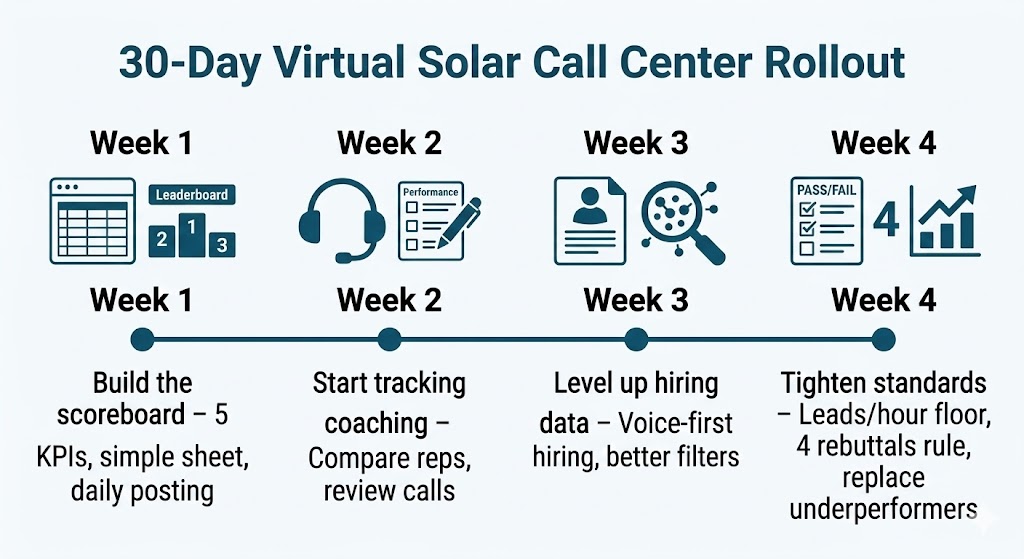
If you don’t have any of this in place yet, here is a simple rollout.
Week 1: Build the Scoreboard
- Decide on your 5 KPIs: hours worked, dials, connections, leads, wrong numbers.
- Set minimums for dials/hour, leads/hour, and contact rate.
- Build a simple sheet with daily columns for contact rate, accuracy, dials/hour, leads/hour, and dials/lead.
- Set a fixed time every morning when yesterday’s numbers get posted in a group chat.
Week 2: Start Tracking and Coaching
- Collect numbers for every rep, every day.
- Compare reps to each other, not to a vague idea of “good.”
- Start listening to “not interested” calls for rebuttal usage and reviewing low leads/hour reps for script adherence.
Week 3: Level Up Hiring and Data
- Launch a voice-first hiring post and start building a bench.
- Test one improved data filter:
- Owner-occupied
- Near median home price
- Ages roughly 40–75
- Filter out HOAs where possible
Watch how those filters affect contact rate and approval potential.
Week 4: Tighten Standards
- Define your leads/hour floor for solar.
- Enforce the four-rebuttal rule.
- Retrain any rep below your floor for two weeks.
- Replace reps whose numbers don’t recover.
If you do this for 30 days, your virtual solar call center will catch problems earlier, spend less time arguing about “feelings,” and turn a small group of callers into consistent solar appointments and installs.
The key takeaway is simple:
If you don’t measure it, it’s a mystery.
Once you measure it, it becomes a process you can fix.
FAQ
Q: What KPIs should a virtual solar call center track daily?
Track hours worked, dials made, connections, leads generated, and wrong numbers for each rep. From those, calculate contact rate, accuracy rate, dials/hour, leads/hour, and dials/lead.
Q: What’s a good contact rate for solar cold calling?
For large-scale outbound calling on a triple-line dialer, a 9–15% contact rate is a healthy range. If it suddenly drops, check caller IDs, dialer routing, and list settings before blaming the data.
Q: How many dials per hour should my solar callers hit?
On a triple-line dialer, aim for 160+ dials per hour. Anything under 150 is a concern. Under 140 usually means reps are clocked in but not actually dialing.
Q: What’s a realistic leads-per-hour goal for foreign solar callers?
A common baseline is around 0.33–0.35 leads per hour (about 1 lead every 3 hours). Track your own data and set a floor where anyone below that level goes into focused retraining.
Q: How do I keep my solar caller IDs from being flagged as spam?
Buy enough local numbers and cap each caller ID at 50–75 dials per day (never exceed ~90). Rotate numbers, monitor contact rate daily, and swap out any numbers that start getting flagged.
Q: Is this legal?
A virtual solar call center can be legal, but it needs to be built with the right process and safeguards in place. That includes how you source data, how you manage dialing, and how you avoid calling numbers you should not be calling. If you are going to scale, compliance needs to be part of the system from the beginning.
Q: What about the DNC list?
If you are calling at scale, DNC compliance cannot be an afterthought. Our data includes updated DNC data and Reassigned Numbers Database integration to help support compliance with those lists. That helps reduce avoidable dialing mistakes and gives your team better guardrails as you scale.
Want the full virtual solar call center system laid out step-by-step?
If you don’t want to piece this together on your own, join us in the Solar Masterclass.
Inside the masterclass, we go deeper into:
- How top operators structure virtual and hybrid solar call centers
- The data filters, lists, and dialer setups that keep contact rates in the 9–15% range
- Daily scoreboards, KPIs, and call review rhythms you can copy into your own team
- Simple hiring funnels and pay structures for foreign and domestic callers
The goal is that you leave with a concrete call center playbook you can plug into your business and start turning more dials into qualified solar installs.
Related DealMachine resources
How to Build a Compliant Virtual Solar Call Center That Actually Books Installs frequently asked questions
What should real estate investors know about How to Build a Compliant Virtual Solar Call Center That Actually Books Installs?
Most solar companies don’t need another motivational talk.
How should investors use this guide?
Use the sections and examples in this guide as a starting point. Verify property, market, and local requirements before making an investment decision.
What tools can help real estate investors research this topic?
DealMachine helps real estate investors find property and owner data, organize leads, and manage outreach from one workflow.